
Last Updated on October 12, 2026
Do you need a suitable generator for your RV’s air conditioner? Many RV owners use portable generators to keep their air conditioners running while camping or traveling without shore power. However, choosing the correct generator size is important because an RV air conditioner needs extra power when its compressor starts.
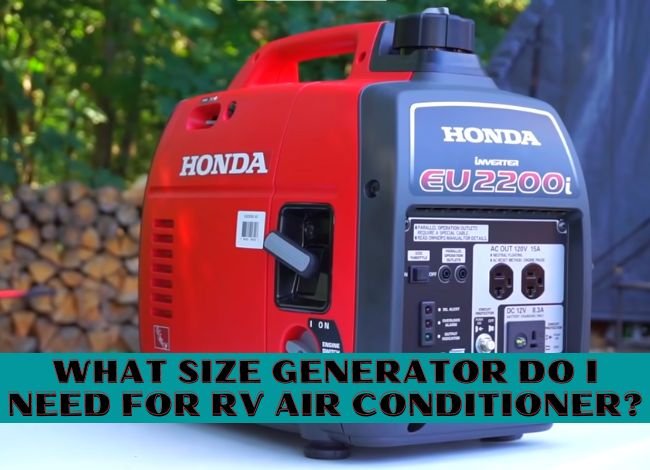
So, what size generator do I need for RV air conditioner operation? For many RVs with a single 13,500 BTU air conditioner, a generator with around 3,000 starting watts is a practical starting point. A 15,000 BTU unit may need more starting capacity, especially without a soft starter.
The exact requirements depend on the air conditioner model, compressor startup demand, and other appliances you want to operate. Let’s look at how to calculate the required power and choose a generator that suits your RV.
What Size Generator Do I Need for RV Air Conditioner?
The right generator must provide enough running watts for the air conditioner and enough starting power to handle the compressor when it turns on.
As a general shopping guide, a 3,000 to 3,500-watt generator is worth considering for a single RV rooftop AC. However, larger units and some air conditioners without soft starters may require a generator with higher surge capacity.
These are only starting recommendations. A generator in this range is not guaranteed to start every RV air conditioner. Always check the air conditioner’s electrical specifications and the generator manufacturer’s compatibility recommendations.
| RV Air Conditioner | Typical Running Power | Generator Sizing Consideration |
|---|---|---|
| 11,000 BTU | Approximately 1,000–1,500 watts | Check whether a 2,000–3,000W generator can handle startup |
| 13,500 BTU | Approximately 1,300–1,800 watts | Consider around 3,000W or more of starting capacity |
| 15,000 BTU | Approximately 1,500–2,000 watts | Consider 3,500–4,500W or more, depending on startup demand |
Note: These are approximate planning ranges, not guaranteed manufacturer ratings. High-efficiency, variable-speed, and soft-start-equipped air conditioners may have different requirements. Always verify the exact model.
How Many Watts Does an RV Air Conditioner Use?
An RV air conditioner uses electrical power to operate its compressor, fan, and controls. The amount of electricity required depends on its cooling capacity, design, and operating conditions.
The BTU rating describes how much heat an air conditioner can remove in an hour. It does not directly tell you how many electrical watts the unit consumes.
13,500 BTU RV Air Conditioner
A typical 13,500 BTU RV air conditioner may consume approximately 1,300 to 1,800 watts during operation. Actual power use varies by model.
For example, a Dometic 13,500 BTU rooftop air conditioner may have a rated cooling current of about 12.5 amps at 115 volts. Multiplying voltage by current gives approximately 1,438 volt-amperes, but that is apparent power, not necessarily the exact real wattage.
When the compressor starts, it may briefly require considerably more current. The generator must be able to handle that starting surge.
15,000 BTU RV Air Conditioner
A 15,000 BTU RV air conditioner often consumes around 1,500 to 2,000 watts while running, although some models use less or more.
Its compressor may also draw substantial current during startup. A conventional fixed-speed compressor can be particularly demanding when starting under hot conditions or when system pressure has not fully equalized.
This is why a generator with 2,000 running watts may have enough power to operate certain 15,000 BTU air conditioners after startup but still fail to start the compressor.
What Is the Difference Between Starting Watts and Running Watts?
Understanding these two ratings is one of the most important steps when choosing an RV generator.
Running watts: The electrical power the generator can supply continuously while appliances are operating.
Starting watts: The additional short-term power available to help start motors and compressors.
Suppose your RV air conditioner normally uses 1,700 watts. If the compressor requires a much higher surge when starting, the generator must handle that surge without overloading or shutting down.
A generator advertised as 3,500 watts may provide only 3,000 watts continuously. That is why you should compare both ratings instead of relying on the largest number printed on the generator.
Can a Soft Starter Help Run an RV Air Conditioner With a Smaller Generator?
Yes. A compatible soft starter can significantly reduce the current required when an RV air conditioner’s compressor starts.
A soft starter controls the compressor startup process rather than allowing the full starting surge to occur all at once. This can make it easier for some generators to start the air conditioner.
For example, an RV air conditioner that struggles to start with a smaller inverter generator may operate successfully after a properly selected soft starter is installed.
However, a soft starter does not eliminate the air conditioner’s normal running power requirement. It also does not guarantee that every 2,000-watt generator will run a 15,000 BTU air conditioner.
Check compatibility with the air conditioner manufacturer and have the soft starter installed according to its instructions. Dometic, for example, advises selecting a correctly sized generator and may require a hard-start device or compatible soft-start system for certain AC installations.
How Can I Select the Perfect Generator Size for My RV?
Choosing the right generator is easier when you consider more than the air conditioner’s wattage alone.
1. Check the Air Conditioner’s Electrical Rating
Look for the manufacturer’s nameplate, owner’s manual, or installation instructions. Important details include voltage, rated current, compressor startup requirements, and recommended generator capacity.
If the air conditioner lists only amperage, you can multiply its rated voltage by its current to estimate volt-amperes. Actual watts may differ because AC motors have a power factor.
2. Calculate the Power Used by Other Appliances
Your air conditioner may not be the only appliance running inside the RV. Refrigerators, battery converters, microwave ovens, and other equipment also consume electricity.
For example, consider these hypothetical loads:
| Appliance | Example Running Watts |
|---|---|
| RV air conditioner | 1,700W |
| RV battery converter | 300W |
| Lights and small electronics | 100W |
| Total | 2,100W |
In this example, the generator must supply at least 2,100 continuous watts, plus a reasonable operating margin. It must also handle the air conditioner’s starting demand and any other motor loads that start at the same time.
The microwave or electric water heater may need to remain off while the AC is operating if the generator cannot handle the combined load.
3. Consider the Generator’s Weight and Portability
A larger generator can provide more power, but it may also be heavier, louder, and more difficult to transport.
If you frequently change campsites, a portable inverter generator may be more convenient than a large open-frame model.
For example, our Champion 3100 Watt Inverter Generator review covers an RV-ready model rated at 3,100 starting watts and 2,800 running watts. Those ratings can help you compare its capacity with your RV’s electrical requirements.
Another option worth comparing is the WEN 56380i inverter generator, which has a higher rated output. Neither generator is guaranteed to start every rooftop AC, so always check compatibility before purchasing.
4. Check the RV’s Electrical Connection
Many RVs use either a 30-amp, 120-volt shore power connection or a 50-amp, 120/240-volt split-phase connection.
A typical 30-amp RV connection can provide up to 3,600 volt-amperes at 120 volts. A typical 50-amp split-phase RV connection has a much higher total capacity, but the actual available power depends on the generator and how the electrical loads are distributed.
A matching RV outlet does not necessarily mean the generator can deliver the maximum power associated with that connector. Always check its rated output.
Use only properly rated cords and approved adapters designed for the RV and generator. Never modify electrical plugs to make incompatible equipment connect.
5. Consider Altitude and Weather
Generator performance can change with altitude and temperature. Many gasoline-powered generators produce less power at higher elevations because thinner air reduces engine output.
Meanwhile, an RV air conditioner may have to work harder in very hot weather.
If you regularly camp in the mountains or desert, check the generator manufacturer’s altitude and temperature derating information. Choosing a generator with some additional capacity can be helpful.
How Can I Power an RV Air Conditioner With a Portable Generator?
A portable generator can operate an RV air conditioner when the electrical ratings and connections are compatible. However, you must connect it correctly and keep it in a safe location.
Step 1: Position the Generator Safely
Place the generator outdoors, at least 20 feet from the RV’s doors, windows, and ventilation openings, with the exhaust pointing away from the RV and nearby occupied spaces.
Never operate a portable fuel-powered generator inside the RV, underneath it, in an enclosed compartment not specifically designed for generator operation, or near an open window.
Keep working carbon monoxide detectors inside the RV. Generator exhaust contains carbon monoxide, which can be deadly even when you cannot smell it.
Step 2: Check the RV’s Power System
Turn off major electrical appliances before connecting the generator. Identify the RV’s approved shore power inlet and check the generator’s outlet type, voltage, and power rating.
If the RV has an automatic or manual transfer switch, leave it installed and follow the manufacturer’s operating instructions. Never remove or bypass a transfer switch to connect the generator.
Step 3: Connect the Generator
Use a properly rated RV power cord and, if needed, an approved adapter compatible with the generator outlet and RV inlet.
With electrical loads switched off, follow the generator and RV manufacturers’ procedures for starting the generator and transferring to generator power.
Some generators and RV electrical systems have specific grounding, neutral, or transfer-switch requirements. If you are unsure about compatibility, ask a qualified RV technician or electrician.
Step 4: Start the Air Conditioner
Once generator power is stable, turn on the air conditioner according to the manufacturer’s instructions.
Watch for generator overload warnings, unusual compressor noises, or repeated startup failures. If the generator struggles, switch the AC off and check the electrical requirements before trying again.
Avoid switching on several large electrical loads at the same time. Starting the air conditioner before adding other permitted loads may reduce the chance of an overload.
Why Won’t My Generator Run My RV Air Conditioner?
Sometimes a generator starts normally but shuts down as soon as the RV air conditioner turns on. Several problems can cause this.
- Insufficient starting watts: The generator cannot handle the compressor’s initial surge.
- Too many appliances: The combined electrical load exceeds the generator’s capacity.
- High altitude: The generator engine may produce less power than its sea-level rating.
- Incorrect electrical connection: The RV and generator may have incompatible wiring or neutral arrangements.
- Generator overload: The generator’s overload protection may shut off electrical output.
- Air conditioner problems: A failing compressor, capacitor, or other component may increase startup difficulty.
Do not repeatedly force the compressor to start. If the setup should have sufficient capacity but still fails, have the generator and air conditioner checked by a qualified technician.
Frequently Asked Questions
1. Will a 2,000-watt generator run an RV air conditioner?
A 2,000-watt generator may run certain small or energy-efficient RV air conditioners, especially with a compatible soft starter. However, many conventional 13,500 or 15,000 BTU rooftop units require more starting power than a typical 2,000-watt generator can provide.
2. Will a 3,500-watt generator run a 15,000 BTU RV air conditioner?
It can run many 15,000 BTU RV air conditioners, but successful startup depends on the actual generator’s continuous and surge ratings, AC compressor requirements, and other connected loads. A soft starter may help in some installations.
3. Can I run two RV air conditioners on one generator?
Yes, if the generator provides enough continuous power for both air conditioners and enough starting capacity for their compressors. Running two conventional rooftop units usually requires substantially more capacity than running one, and an RV’s electrical system must also support the load.
4. Does a soft starter reduce RV air conditioner power consumption?
A soft starter mainly reduces the compressor’s startup current. It does not significantly reduce the air conditioner’s normal power consumption while cooling.
5. Can I run my RV air conditioner all night on a generator?
Yes, if the generator is designed for the required operating duration, has adequate fuel, and is operated safely according to the manufacturer’s instructions. Always consider campground noise rules, carbon monoxide safety, and fuel consumption before overnight operation.
6. Is an inverter generator better for an RV air conditioner?
An inverter generator can be a good option because many models provide stable electrical output and operate relatively quietly at lower loads. However, it must still have enough running and starting capacity for the air conditioner.
Final Thoughts
So, what size generator do I need for RV air conditioner use? For a single 13,500 BTU unit, a generator around 3,000 starting watts may be suitable in many situations. A 15,000 BTU unit may require a larger generator, particularly if it does not have a soft starter.
Before buying, check the air conditioner’s electrical requirements, generator starting and running watts, RV connection, and other appliances you plan to use.
The right generator will help you stay comfortable while camping without unnecessarily overloading your electrical system. Always prioritize safe outdoor generator operation and proper electrical connections.