
Last Updated on October 10, 2026
Being an outdoor enthusiast, I’ve come across many portable power station options for camping and backup electricity. Some offer enough power for large appliances, while others are better suited for charging phones, cameras, and other small electronics.
The Goal Zero Yeti 150 belongs to the second category. It’s a compact, battery-powered generator alternative that provides portable electricity without gasoline, exhaust fumes, or a noisy engine.
Although the Yeti 150 is an older model, it can still be useful for occasional camping trips or basic emergency backup power. However, its lead-acid battery and limited AC output are important factors to consider before buying one today.
In this Goal Zero Yeti 150 Review, we’re going to look at its features, battery performance, charging options, advantages, disadvantages, and maintenance requirements. We’ll also discuss whether this older power station is still worth purchasing.
Technical Specifications of the Goal Zero Yeti 150 Portable Power Station
| Features | Goal Zero Yeti 150 |
|---|---|
| Model: | Yeti 150 |
| Power Source: | Rechargeable battery |
| Battery Type: | AGM lead-acid |
| Battery Capacity: | 168Wh (12V, 14Ah) |
| AC Output: | 80W continuous |
| AC Surge Output: | 160W maximum |
| Inverter: | Modified sine wave |
| AC Outlet: | 1 x 110V AC (US model) |
| USB Outputs: | 2 x USB-A, 5V, up to 2.1A combined |
| 12V Outputs: | 1 x 12V car port and 1 x 6mm port, up to 10A each |
| Total Output Ports: | 5 |
| Charging Input: | 8mm port, up to 60W |
| Wall Charging Time: | Approximately 6 hours |
| Car Charging Time: | Approximately 8 hours with compatible charger |
| Solar Charging: | Compatible Goal Zero solar panels |
| Weight: | 12 pounds (5.4 kg) |
| Dimensions: | 7.75 x 5.75 x 6.75 inches |
| Operating Temperature: | 32°F to 104°F (0°C to 40°C) |
| Product Status: | Archived older model |
| Price: | 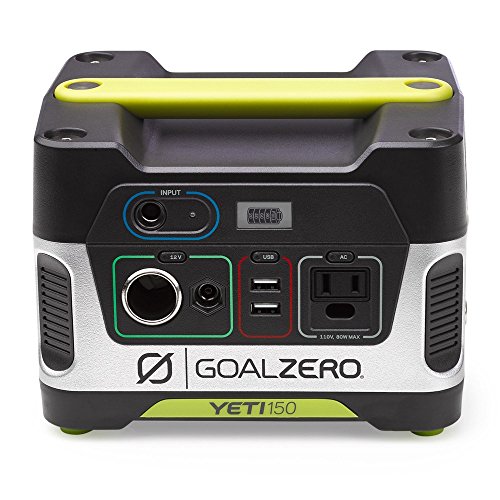 Check Price and Availability on Amazon |
Note: Specifications are based on the US version of the original Yeti 150. International versions may have different AC outlet voltages. Availability and battery condition can vary because this is an older model.
Goal Zero Yeti 150 Review 2027: Features and Performance
With a weight of just 12 pounds, the Goal Zero Yeti 150 is easy to carry on short camping trips or keep in your vehicle for emergencies.
It doesn’t offer the high capacity or advanced features of larger power stations such as the Goal Zero Yeti 3000 power station. However, it was designed for a different purpose: providing simple portable power for smaller electronic devices.
Let’s take a closer look at its features.
[toc]
Sturdy and Compact Construction
The Yeti 150 has a sturdy plastic housing that protects its internal battery and electrical components during normal use.
The casing also gives the unit a compact shape, making it easy to store on a shelf, in a vehicle, or alongside your camping equipment.
Its front panel contains the charging input, battery display, output ports, and individual power buttons.
Everything is positioned within easy reach, so you won’t have to search around the unit when connecting your devices.
However, the Yeti 150 is not waterproof or weatherproof. You should protect it from rain, snow, dust buildup, and excessive moisture.
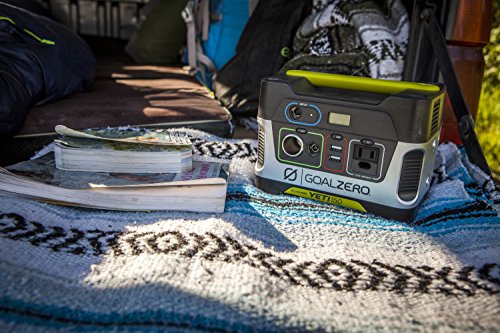
When camping, place the power station on a dry, stable surface with enough ventilation around it.
Stylish and Portable Design
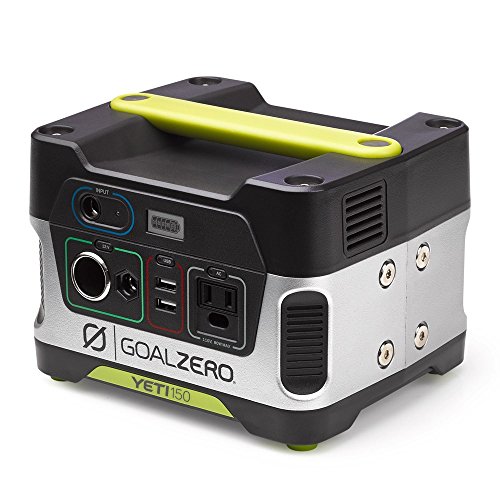
The Goal Zero Yeti 150 has a simple, attractive design with a combination of black, gray, and green colors.
Its compact body and built-in carrying handle make it easy to move from one place to another.
At 12 pounds, it is manageable for most adults, although it is heavier than many modern lithium-powered stations with similar battery capacities.
This extra weight mainly comes from its AGM lead-acid battery.
For short trips, the size is convenient. You can store it in your vehicle or carry it to a campsite without needing a large equipment case.
However, if you plan to carry a power station over long hiking distances, a lighter lithium-powered model may be more comfortable.
Power Multiple Devices
One of the useful features of the Goal Zero Yeti 150 is its five output ports.
These include one AC outlet, two USB-A ports, one 12V car outlet, and one 12V 6mm output.
This means you can connect several compatible devices at once, provided their total power requirements remain within the station’s output limits.
Some suitable devices include:
- Smartphones and basic mobile devices.
- Digital cameras and rechargeable camera batteries.
- LED lights and small camping lanterns.
- Tablets and e-readers.
- Small rechargeable accessories.
- Some low-power laptops with compatible charging requirements.
The AC outlet provides up to 80 watts continuously, with a maximum surge rating of 160 watts.
However, the 160W surge rating is only intended for brief startup demands. It does not mean the station can continuously run a 160W appliance.
The 12V outputs have different limits, and you should check the connected device’s voltage, current, and connector requirements before use.
Also, avoid running several high-draw devices simultaneously. The total output must remain within the manufacturer’s limits.
 Check Price on Amazon
Built-In Modified Sine Wave Inverter
The Yeti 150 comes with a built-in modified sine wave inverter.
This converts the battery’s DC electricity into AC power for compatible devices.
As a result, you don’t need to purchase a separate inverter for basic AC applications.
However, modified sine wave power is different from the pure sine wave output found in many newer portable power stations.
Some electronic devices, particularly sensitive equipment, certain chargers, and motor-driven appliances, may not operate correctly with a modified sine wave inverter.
For this reason, you should check your device’s power requirements and compatibility before connecting it to the Yeti 150.
If you regularly need to power sensitive electronics, a power station with a pure sine wave inverter is generally the better choice. For comparison, the older Goal Zero Yeti 1000 lithium model offers a different battery system and much higher power capacity.
168Wh AGM Lead-Acid Battery
The Goal Zero Yeti 150 uses a 168Wh AGM lead-acid battery rated at 12V and 14Ah.
AGM stands for Absorbent Glass Mat, a sealed lead-acid battery design that requires less routine maintenance than traditional flooded lead-acid batteries.
This battery technology was common in older portable power stations.
It can provide dependable backup power when maintained correctly, but it has some limitations compared with modern lithium batteries.
For example, AGM batteries are relatively heavy and can lose capacity if repeatedly left discharged.
They also have a more limited cycle life than many current lithium iron phosphate (LiFePO4) batteries.
Another important point is that the Yeti 150’s 168Wh rating represents its nominal battery capacity. Not all of that energy will reach your devices because some power is lost during conversion and operation.
For a larger older Goal Zero model, our Yeti 400 lead-acid power station review discusses another option with greater battery capacity.
How Long Does the Goal Zero Yeti 150 Last?
Battery runtime depends on how much power your device consumes.
A small LED light can run much longer than a laptop drawing 50 or 60 watts.
For a rough estimate, divide the battery’s usable energy by the power consumption of the connected device.
However, lead-acid battery behavior and conversion losses mean the actual runtime can be considerably lower than a simple calculation suggests.
| Device Power | Illustrative AC Runtime |
|---|---|
| 5W | Approximately 14–24 hours |
| 10W | Approximately 7–12 hours |
| 25W | Approximately 3–5 hours |
| 50W | Approximately 1–2 hours |
| 80W | Less than approximately 1.5 hours |
These are broad estimates, not guaranteed runtimes. They assume a healthy battery and allow for conversion losses, inverter overhead, and load-related capacity reduction. Battery age, temperature, and device behavior can change the results considerably. Low-power devices may operate more efficiently from the appropriate DC or USB output than from AC.
For smaller devices like smartphones and LED lanterns, the Yeti 150 can still be useful. But it isn’t designed to provide long-term backup power for large appliances.
Easy to Use With an LCD Battery Display
Using the Yeti 150 is straightforward.
First, make sure the battery is charged. Then connect your device to the appropriate output port and press the corresponding power button.
The LCD display shows the approximate battery level using five segments.
This helps you understand how much stored power remains while charging or operating your devices.
However, the display is not a precise watt-hour meter. It doesn’t provide the advanced monitoring features found on many newer power stations.
The individual output buttons are another helpful feature because you can switch off unused ports to avoid unnecessary power consumption.
Quiet Operation Without Gasoline
Another advantage of the Goal Zero Yeti 150 is that it operates without a gasoline engine.
Unlike a traditional generator, it doesn’t require fuel mixing, engine oil changes, or pull-cord starting.
It also produces no engine exhaust during use.
This makes it convenient for indoor backup charging and outdoor activities, provided it is kept dry and used in a properly ventilated location.
However, don’t confuse quiet operation with unlimited power. The Yeti 150 has a much smaller output capacity than a gas-powered generator.
For comparison, our WEN 56200i gas inverter generator review covers a gasoline-powered model designed for substantially higher electrical loads. Unlike a battery power station, a gasoline generator must be operated outdoors, well away from doors, windows, and air intakes because of carbon monoxide risks.
Three Charging Options
The Goal Zero Yeti 150 can be recharged in three different ways: through a wall outlet, a compatible solar panel, or a vehicle’s 12V electrical system using the appropriate charger.
This flexibility is useful when you’re traveling or spending time outdoors.
1. Charging From a Wall Outlet
Using the original 45W wall charger, Goal Zero lists an approximate charging time of six hours.
Actual charging time depends on the battery’s condition and how much charge remains.
For the best results, use the manufacturer-approved charging equipment.
2. Charging From a Vehicle
You can also recharge the Yeti 150 from a vehicle using a compatible 12V car charging adapter.
Goal Zero lists an approximate charging time of eight hours with its 30W car charger.
However, the car charging adapter may need to be purchased separately.
Follow the charging instructions and avoid draining your vehicle’s starting battery when the engine is off.
3. Charging With Solar Panels
Solar charging is one of the most attractive features of the Yeti 150.
It allows you to recharge the power station when you have access to suitable sunlight and compatible charging equipment.
According to Goal Zero’s archived product information, approximate solar charging times include:
- Nomad 20: 12–24 hours.
- Nomad 50: 5–10 hours.
- Boulder 50: 5–10 hours.
These figures depend on sunlight, panel placement, weather, and battery condition.
The Yeti 150 accepts up to 60W through its charging input, so using a much larger panel does not mean it can charge at an unlimited rate.
Make sure the panel’s voltage, connector, and output specifications are compatible with the Yeti 150 before connecting it.
 Check Price on Amazon
Battery Maintenance and Storage
Since the Yeti 150 uses an AGM lead-acid battery, proper storage is especially important.
If you leave the battery discharged for a long time, its capacity may decrease permanently.
Goal Zero recommends keeping the unit connected to a suitable charging source during storage or recharging it at least every three months when continuous charging isn’t possible.
Store the station in a cool, dry location and avoid extreme temperatures.
Also, don’t store it with a completely depleted battery.
If you’re considering a used Yeti 150, ask about the battery’s age and storage history. A unit that looks good externally may still have a battery that can no longer hold a useful charge.
Warranty and Product Availability
The Goal Zero Yeti 150 is now listed among the company’s archived products rather than its current portable power station lineup.
Its older user documentation lists warranty terms that may differ from current Goal Zero policies.
Goal Zero’s published warranty policy includes a six-month warranty exception for lead-acid batteries, including those used in the Yeti 150.
However, coverage depends on the original purchase, product components, and applicable warranty terms.
If you’re buying an older or secondhand unit, don’t assume that it includes a new manufacturer warranty.
Check the seller’s return policy and confirm whether replacement batteries and compatible charging accessories are available.
Pros of the Goal Zero Yeti 150 Solar Generator
- Compact and sturdy construction.
- Portable design with a built-in carrying handle.
- 168Wh battery capacity for small electronic devices.
- Five output ports for connecting compatible equipment.
- 80W continuous AC output.
- Quiet operation without gasoline or engine exhaust.
- Wall, car, and solar charging options.
- Easy-to-read battery level display.
- Individual power buttons for different outputs.
- Simple operation and relatively low routine maintenance.
Cons of the Goal Zero Yeti 150 Portable Power Station
- The 80W AC output is insufficient for many household appliances.
- Modified sine wave inverter may not suit sensitive electronics.
- AGM lead-acid battery is heavier than modern lithium alternatives.
- Battery capacity can decline significantly with age or poor storage.
- Solar charging can take several hours or longer in poor sunlight.
- Limited modern features and no advanced app-based monitoring.
- Archived product with potentially limited replacement-part availability.
- Buying an older unit may not provide good value compared with newer power stations.
What Can the Goal Zero Yeti 150 Power?
Before buying any portable power station, you should check the power requirements of the devices you want to operate.
The Yeti 150 is primarily intended for small electronics.
Here is a simple overview:
| Device | Suitability |
|---|---|
| Smartphones | Yes, through compatible USB charging |
| LED camping lights | Yes, within output limits |
| Digital cameras | Yes, with compatible chargers |
| Tablets | Yes, depending on charging requirements |
| Low-power laptops | Possibly, after checking inverter compatibility |
| Mini refrigerators | Generally not recommended |
| Air conditioners | No |
| Electric kettles | No |
| Space heaters | No |
Remember that the AC outlet is limited to 80W continuous power. Even if a device normally uses less than 80W, its startup surge may exceed the inverter’s limit.
Also, don’t use this power station for essential medical equipment unless the equipment manufacturer confirms compatibility and you have a suitable backup plan.
Is the Goal Zero Yeti 150 Still Worth Buying?
The Goal Zero Yeti 150 can still be useful if you already own one and the battery remains in good condition.
Its compact size, straightforward controls, and multiple charging methods make it convenient for basic outdoor activities.
However, purchasing one today requires more consideration.
The lead-acid battery is heavy for its capacity, and the modified sine wave inverter limits the types of equipment you can safely connect.
Its 80W continuous AC output is also much lower than the output provided by many modern portable power stations.
If you’re buying a used model, test how well the battery holds a charge and check whether all the ports operate correctly.
You should also compare the asking price with newer lithium-powered units that offer a pure sine wave inverter, USB-C charging, and longer battery cycle life.
For another brand comparison, our Jackery battery-powered alternatives article discusses other portable models with different capacities and output ratings.
For most buyers purchasing a new power station, a modern model will usually offer better long-term value unless the Yeti 150 is available at a particularly low price and meets your specific requirements.
Frequently Asked Questions
1. What does the Goal Zero Yeti 150 solar kit include?
The original Yeti 150 power station package included the portable battery unit and a wall charger. Solar kits were available in different configurations with compatible solar panels. If you’re purchasing an older solar kit, check whether the panel, adapter cables, and charger are included. The Yeti 150 itself does not generate electricity from sunlight without an external solar panel.
2. How many times can the Yeti 150 charge a smartphone?
Goal Zero originally advertised up to approximately 15 smartphone recharges under its reference test conditions. However, actual results depend on the phone’s battery capacity, charging efficiency, and the Yeti’s battery condition. Modern smartphones with larger batteries may receive fewer complete charges.
3. Can the Goal Zero Yeti 150 run a refrigerator?
The Yeti 150 is generally not suitable for running household refrigerators. Its AC inverter provides only 80W continuously and 160W for brief surges. Most refrigerators require more power, especially when the compressor starts. A larger power station with sufficient continuous and surge output would be more appropriate.
4. How long does it take to recharge the Goal Zero Yeti 150?
Goal Zero lists approximately six hours using the original wall charger and eight hours with a compatible car charger. Solar charging varies considerably. For example, the Boulder 50 panel is listed at approximately 5–10 hours under suitable sunlight conditions.
5. Can I replace the battery in the Goal Zero Yeti 150?
The Yeti 150 uses an internal AGM lead-acid battery, and replacement may be possible with a compatible battery and the proper procedure. However, compatibility must be confirmed carefully. If you’re unfamiliar with battery replacement or electrical safety, contact Goal Zero support or a qualified technician rather than opening the unit yourself.
6. Is the Goal Zero Yeti 150 better than a modern lithium power station?
Not necessarily. The Yeti 150 can still handle basic charging tasks, but modern lithium-powered models often provide better energy density, longer cycle life, higher AC output, and pure sine wave inverters. The Yeti 150 may be worth keeping if you already own a healthy unit, but a newer model is generally more practical for someone buying a portable power station today.
Final Thoughts
Overall, the Goal Zero Yeti 150 is a compact and easy-to-use portable power station designed for small electronic devices.
It comes with a 168Wh AGM lead-acid battery, an 80W modified sine wave inverter, five output ports, and three different charging methods.
Its main advantages are portability, quiet operation, and simple controls. However, the limited AC output, older battery technology, and product age are important drawbacks.
If you already own this model, keeping the battery properly maintained can help you continue using it for basic camping and emergency charging.
But if you’re buying a portable power station today, compare it with newer lithium-powered alternatives before spending your money.
I hope this Goal Zero Yeti 150 Review helps you understand the product’s strengths, limitations, and whether it is suitable for your needs.