

Last Updated on October 24, 2026
Finding an affordable and powerful pressure washer is not always easy. Some brands offer inexpensive products, but they don’t always perform as expected. As a result, you need a machine that is affordable, reliable, and powerful enough for your cleaning needs. One brand worth considering is Ryobi. Read this Ryobi 1600 PSI Pressure Washer Review to learn more about this compact electric cleaning machine.
Ryobi offers several pressure washers, but today, we will look at the Ryobi 1,600 PSI electric pressure washer, particularly model RY141612. This machine is reasonably priced and performs well for everyday household cleaning. It features a compact design, a 13-amp electric motor, and a 35-foot power cord. The lightweight construction makes it suitable for homeowners who need a portable pressure washer for washing cars, patio furniture, and other outdoor surfaces.
Technical Specifications of the Ryobi 1600 PSI Pressure Washer
| Features | Ryobi 1600 PSI Pressure Washer |
|---|---|
| Model | RY141612 |
| Maximum Pressure | 1600 PSI |
| Maximum Water Flow | 1.2 GPM |
| Calculated Cleaning Units | 1920 CU (PSI × GPM) |
| Motor | 13-amp electric motor |
| Power Supply | 120V AC, 60Hz |
| Power Cord Length | 35 feet |
| High-Pressure Hose | 20 feet |
| Pump Type | Axial |
| Start Type | Electric on/off switch |
| Included Nozzles | 15°, Turbo, Soap |
| Nozzle Connection | 1/4-inch quick-connect |
| Detergent System | External soap injection hose with filter |
| Additional Features | GFCI plug, onboard cord and hose storage, carrying handle |
| Water Capability | Cold water only |
| Weight | Approximately 16.39 pounds |
| Dimensions | Approximately 18.3 × 11.02 × 9.85 inches |
| Pressure Rating Standard | PWMA PW101 |
| Warranty | 3-year limited warranty |
| Price | 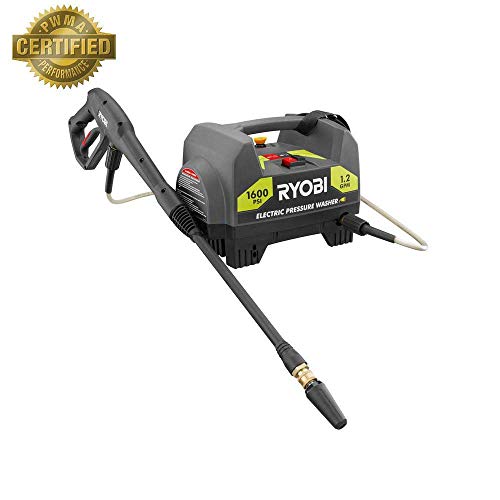 Check Price on Amazon |
With three quick-connect nozzles, this pressure washer can handle various tasks, including cleaning cars, patios, outdoor furniture, and garden equipment. However, the correct nozzle and spraying distance are important to avoid damaging delicate surfaces.
Let’s take a closer look at its features, cleaning performance, advantages, and disadvantages.
Ryobi 1600 PSI Pressure Washer Review 2026: Features and Performance
[toc]
Durable Construction
As small as this electric pressure washer appears, it is built with sturdy components for regular residential cleaning. Its durable plastic housing helps protect the motor and pump from everyday bumps during use.
The compact design also makes it convenient for homeowners who don’t have much storage space. However, plastic housing still requires careful handling. Avoid dropping the machine or placing heavy objects on top of it.
When you’re finished cleaning, store it in a dry location where the machine will be protected from freezing temperatures and accidental damage.
Compact and Lightweight Design
Apart from being durably constructed, the Ryobi 1600 PSI pressure washer has a compact design. This means it can fit into relatively tight storage spaces without taking up much room.
Weighing approximately 16.39 pounds, it is lightweight compared with many larger pressure washers, including some Ryobi 1700 PSI pressure washer models.
You can easily lift this machine from your garage to the driveway or carry it around your backyard. Its small size is particularly useful when washing vehicles or cleaning furniture in different locations.
However, the unit doesn’t have wheels. So, you may need to lift and reposition it more frequently when cleaning larger areas.
13-Amp Electric Motor
Another excellent feature of this unit is its 13-amp electric motor. It produces enough power to handle many light-duty residential cleaning tasks without the maintenance requirements of a gasoline engine.
The machine delivers a maximum rated pressure of 1600 PSI and a maximum water flow of 1.2 GPM. Multiplying these ratings gives 1920 cleaning units, although maximum pressure and maximum flow may not occur simultaneously during actual operation.
This cleaning capacity is useful for washing bicycles, garden tools, outdoor furniture, grills, and moderately dirty patios.
However, heavily stained concrete and extensive driveway cleaning may require a more powerful machine. If you need additional cleaning power, check our Ryobi 3100 PSI pressure washer review.
Three Quick-Connect Nozzles
Most homeowners want an affordable pressure washer that can handle different cleaning jobs. Fortunately, the Ryobi 1600 PSI electric pressure washer comes with three quick-connect nozzles.
- 15-degree nozzle: Produces a concentrated spray for removing dirt from suitable hard surfaces.
- Turbo nozzle: Creates a rotating spray for tougher cleaning jobs, such as removing stubborn grime from durable concrete surfaces.
- Soap nozzle: Activates the detergent injection system for applying cleaning solutions.
These nozzles allow you to clean different surfaces, but they must be used carefully.
The turbo nozzle is not suitable for vehicle paint, delicate wood, soft stone, or fragile siding. Even the 15-degree nozzle can damage sensitive surfaces if held too close.
For vehicle washing, a compatible wider-angle nozzle is usually a safer choice. Always test the spray on a small area before cleaning the entire surface.
35-Foot Power Cord
Since the pressure washer is powered by electricity, it comes with a 35-foot power cord that gives you a reasonable working range.
This makes it easier to clean around your driveway or patio without constantly changing electrical outlets.
If you need an extension cord, follow the exact requirements in your Ryobi operator’s manual. The RY141612 manual specifies heavy-duty outdoor extension cords of suitable wire gauge and length.
Never use an undersized, damaged, or indoor-only extension cord. Keep all electrical connections dry and away from standing water.
For the safest setup, connect the machine directly to a suitable electrical outlet whenever possible.
20-Foot High-Pressure Hose
Like the Greenworks 1600 PSI pressure washer, this unit is designed for convenient household cleaning.
The Ryobi RY141612 includes a 20-foot high-pressure hose, which provides enough reach for many small cleaning jobs.
However, you may need to move the machine when washing larger vehicles or cleaning an entire driveway.
Ryobi recommends using an appropriate cold-water supply. Never connect the machine to a hot-water source unless the manufacturer specifically approves it.
Relatively Quiet Operation
One of the biggest disadvantages of many gas-powered pressure washers is their noise.
Although electric pressure washers still produce sound during operation, the Ryobi 1600 PSI model is generally quieter than many gasoline-powered machines.
It also produces no engine exhaust fumes. This makes it convenient for homeowners who want a cleaning machine for regular outdoor maintenance without storing gasoline.
Convenient Carrying Handle
Even without wheels, this pressure washer is easy to transport because of its lightweight construction.
It features a carrying handle that allows you to lift and move the machine around your property.
This is especially helpful when cleaning smaller areas where you need to reposition the unit frequently.
Before moving the pressure washer, release the trigger, switch it off when appropriate, and make sure the hoses and power cord are not creating a tripping hazard.
Three-Year Limited Warranty
Last but not least, Ryobi offers a three-year limited warranty on this pressure washer.
The warranty covers qualifying defects in materials and workmanship under the manufacturer’s terms.
However, damage caused by misuse, improper maintenance, freezing, or unauthorized modifications may not be covered.
Always keep your purchase receipt and check the warranty documentation for the exact coverage applicable to your machine.
Related article: Explore the Karcher K5 Premium 2000 PSI electric pressure washer.
Troubleshooting the Ryobi 1600 PSI Electric Pressure Washer
Although the Ryobi 1600 PSI pressure washer is designed for easy operation, you may occasionally experience starting problems, weak water pressure, or detergent issues.
The following table explains some common problems and how to troubleshoot them.
| Issue | Possible Cause | Solution |
|---|---|---|
| Pressure washer not starting | Faulty outlet, tripped GFCI, power switch turned off, or electrical problem | Check the electrical outlet, reset the GFCI, and confirm that the switch is ON. Contact an authorized technician if the machine still won’t start. |
| Intermittent operation or unexpected shutdown | Clogged nozzle, electrical supply problem, or overheating | Check the nozzle and electrical connection. Switch off the machine and allow it to cool before restarting. |
| Low-pressure output | Insufficient water supply, kinked hose, clogged inlet filter, or blocked nozzle | Open the water supply fully, remove hose restrictions, clean the inlet filter, and inspect the nozzle. |
| Detergent not dispensing | Incorrect nozzle, soap hose not submerged, or blocked detergent filter | Attach the soap nozzle, place the detergent hose into the cleaning solution, and inspect the filter. |
| GFCI plug trips repeatedly | Ground fault, moisture intrusion, or damaged electrical components | Stop using the machine and disconnect it from power. Have the electrical system inspected by a qualified technician. |
| Water leaking from spray wand | Loose connection or damaged O-ring | Release pressure, inspect the connection, and replace the damaged O-ring if necessary. |
| Pressure fluctuates during operation | Air trapped inside the system or restricted water supply | With the motor off and water running, squeeze the trigger until a steady stream appears. Check the hose and inlet filter. |
Important: Always switch off the pressure washer, disconnect the power supply, turn off the water, and squeeze the trigger to release trapped pressure before inspecting or changing parts.
What We Liked About the Ryobi 1600 PSI Electric Pressure Washer
- Durable construction for regular home cleaning
- Compact and lightweight design
- 13-amp electric motor provides useful cleaning performance
- Three quick-connect nozzles for different applications
- 35-foot power cord for convenient operation
- 20-foot high-pressure hose
- Easy-to-carry design with a built-in handle
- Onboard hose and cord storage
- PWMA-rated maximum pressure
- Relatively quiet operation compared with many gas-powered models
- Three-year limited warranty
What We Didn’t Like About the Ryobi 1600 PSI Pressure Washer
- Not powerful enough for demanding heavy-duty cleaning jobs. For larger projects, consider a machine such as the Ryobi 3000 PSI pressure washer.
- Doesn’t include wheels, so you need to lift it when changing locations.
- The 20-foot hose may feel short when cleaning larger vehicles or driveways.
- No onboard detergent tank on the RY141612 model.
- The included high-pressure nozzles require extra care around delicate surfaces.
Ryobi 1600 PSI vs 1800 PSI Electric Pressure Washer Comparison
Both the Ryobi 1600 PSI and 1800 PSI electric pressure washers are designed for residential cleaning. However, the exact features of the 1800 PSI version depend on its model number.
| Specification | Ryobi 1600 PSI (RY141612) | Ryobi 1800 PSI Compact Model |
|---|---|---|
| Maximum Pressure | 1600 PSI | 1800 PSI |
| Maximum Flow Rate | 1.2 GPM | 1.2 GPM on common compact versions |
| Motor | 13-amp electric | Electric; check exact model |
| Weight | Approximately 16.39 pounds | Varies by model |
| High-Pressure Hose | 20 feet | Usually 20 feet on compact versions |
| Power Cord | 35 feet | Check model specifications |
| Nozzles | 15°, Turbo, Soap | Varies by model |
| Detergent System | External soap injection hose | Depends on model |
| Portability | Compact carrying design | Compact design on portable models |
| Warranty | 3-year limited warranty | Check exact model warranty |
The 1800 PSI model provides slightly higher rated pressure, which may help with certain cleaning jobs. However, the difference is not large enough to make either machine suitable for demanding commercial cleaning.
If portability and affordability are your main priorities, the 1600 PSI model is worth considering. If you frequently clean stubborn dirt from harder surfaces, the 1800 PSI version may offer a small advantage.
How to Maintain the Ryobi 1600 PSI Pressure Washer
Proper maintenance can help your pressure washer perform reliably and reduce common problems.
- Clean the water inlet filter: Check it regularly and remove any trapped debris.
- Inspect the spray nozzles: Clean blocked nozzles using the recommended cleaning tool.
- Check the high-pressure hose: Look for cracks, leaks, and damaged connections.
- Flush the detergent system: Run clean water through the soap injection system after using detergent.
- Keep electrical connections dry: Protect the plug and power cord from standing water.
- Store the machine properly: Drain remaining water and protect the pump from freezing temperatures.
Never operate the pressure washer without a suitable water supply, as running the pump dry can cause damage.
Conclusion: Is the Ryobi 1600 PSI Pressure Washer Worth Buying?
If you’ve been looking for an affordable and compact electric pressure washer, the Ryobi 1600 PSI model is worth considering. It is a practical choice for homeowners who want a portable machine for occasional cleaning.
The 13-amp motor, three quick-connect nozzles, lightweight construction, and convenient carrying handle make it suitable for everyday use. Unlike larger Generac gas-powered pressure washers or some Simpson cleaning machines, it doesn’t require gasoline or engine oil changes.
Whether you want to clean your car, patio furniture, garden equipment, or lightly dirty outdoor surfaces, this unit can handle many common jobs when used correctly.
However, it is not the best choice for heavy-duty driveway cleaning or commercial applications. For those tasks, a more powerful pressure washer may be necessary.
Overall, the Ryobi RY141612 offers a useful combination of portability, convenience, and cleaning performance. We hope this Ryobi 1600 PSI Pressure Washer Review helps you make the right purchasing decision.
Frequently Asked Questions
How do I use soap with the Ryobi 1600 PSI pressure washer?
The RY141612 doesn’t have an onboard detergent tank. Instead, it uses an automatic soap injection system with an external suction hose and filter. Place the filter end of the hose inside a container of compatible pressure washer detergent, attach the soap nozzle, and operate the machine. The soap nozzle activates the detergent injector.
What type of extension cord should I use with this pressure washer?
Use only an outdoor-rated extension cord that meets the electrical requirements in the operator’s manual. The RY141612 manual specifies suitable heavy-duty cord sizes based on length. Never use an undersized extension cord or place electrical connections in water. Connecting directly to a suitable outlet is preferable when possible.
Can the Ryobi 1600 PSI pressure washer damage car paint?
Yes. Even a 1600 PSI machine can damage vehicle paint if the nozzle is too concentrated or held too close. Avoid using the turbo nozzle on painted surfaces. A compatible wider-angle nozzle and appropriate spraying distance are safer choices for washing vehicles.
Can I clean my driveway with this pressure washer?
Yes, it can remove light dirt and grime from small concrete areas. However, heavily stained or large driveways may require a machine with higher pressure and greater water flow.
Does the Ryobi 1600 PSI pressure washer require oil?
The machine uses an electric motor, so it doesn’t require gasoline engine oil changes. Follow the manufacturer’s maintenance instructions for the pump and other components.
Can I use hot water with the Ryobi RY141612?
No. This model is intended for cold-water cleaning. Avoid connecting it to a hot-water supply because excessive inlet temperatures can damage the pump and other components.
Why is my Ryobi pressure washer losing pressure?
Common causes include insufficient water flow, a kinked garden hose, a clogged inlet filter, trapped air, or a blocked spray nozzle. Check these components before assuming the pump is defective.
Still have a question after reading this Ryobi 1600 PSI Pressure Washer Review? Feel free to comment below.
Can I plug this portable Ryobi 1600psi to 220 volts??? How much is the wattages of the motor??
Ryobi 1600 is built to work with United States Electrical Standards. It is designed to work only with 110V power outlets. If you want to use 220 volts, then A voltage converter would be necessary.