
Last Updated on October 18, 2026
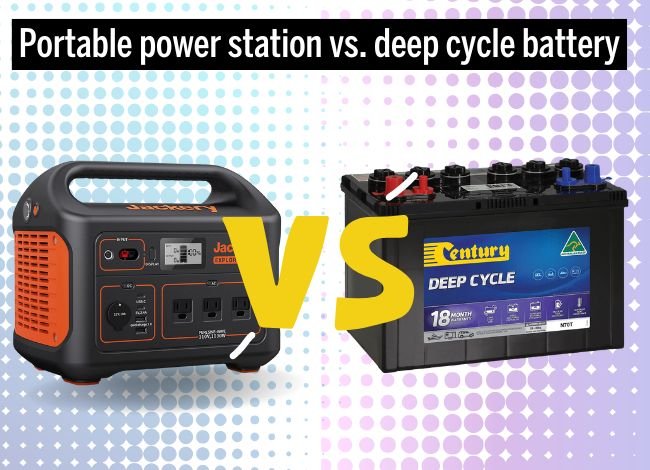
A portable power station is becoming a popular choice for powering electronic devices during camping trips, outdoor activities, and electricity outages. Depending on its capacity, it can operate smartphones, laptops, lights, fans, and even some household appliances.
Portable power stations are sometimes compared with ordinary power banks. However, they usually have larger batteries, more output connections, and additional features such as built-in inverters and solar charging support.
The battery is the main energy storage component of a portable power station. But instead of purchasing a complete power station, some people prefer using a separate deep-cycle battery.
At first glance, a deep-cycle battery may look similar to a regular car battery. However, the two are designed for different purposes. A starting battery provides a large amount of current for a short time, while a deep-cycle battery is designed to deliver energy over longer periods and tolerate repeated discharge cycles.
So, which option should you choose?
In this portable power station vs. deep cycle battery comparison, we will discuss their differences in capacity, runtime, charging, durability, portability, and cost.
Portable Power Station vs. Deep Cycle Battery: Comparison Table
The biggest difference is that a portable power station is a complete power system, while a deep-cycle battery is primarily an energy storage component.
A power station generally includes a battery, charging electronics, protection circuits, and output ports in one portable unit.
A separate deep-cycle battery usually requires additional equipment before it can safely power household appliances.
| Feature | Portable Power Station | Deep-Cycle Battery |
|---|---|---|
| Power Output | Varies by model, from small USB outputs to several thousand watts of AC power | Depends on battery specifications and connected inverter |
| Usability | Generally plug-and-play | Usually requires additional setup |
| Battery Capacity | Commonly 200Wh to 3,000Wh or more | Often 50Ah to 200Ah or more, depending on the system |
| Battery Chemistry | Usually lithium-ion or LiFePO4 | Flooded lead-acid, AGM, gel, or LiFePO4 |
| AC Inverter | Usually built in on models with AC outlets | Requires a separate inverter for AC appliances |
| Charging System | Built-in charging electronics | Requires a compatible charger or charging controller |
| Charging Methods | Wall outlet, solar, and vehicle charging on compatible models | Compatible AC charger, solar charge controller, or vehicle charging system |
| Output Connections | Often AC, USB, and DC ports | Battery terminals; additional connections require accessories |
| Portability | Usually convenient for carrying and transport | Depends on battery size, chemistry, and installation |
| Cycle Life | Varies; modern LiFePO4 models may offer 3,000+ rated cycles | Varies widely by chemistry and discharge depth |
| Maintenance | Generally low | Low for sealed or lithium batteries; flooded lead-acid requires more maintenance |
| Expandability | Model-dependent; some support extra batteries | Can be designed as a larger battery bank with suitable equipment |
| Best Applications | Camping, emergencies, portable electronics, and temporary backup power | RVs, boats, solar storage, off-grid systems, and custom backup power |
What Is a Portable Power Station?
A portable power station is a rechargeable battery-powered device designed to supply electricity without requiring a running gasoline engine.
Most modern models combine several components inside one housing:
- Rechargeable battery pack.
- Battery management system.
- AC inverter, if the model provides AC outlets.
- USB and DC output connections.
- Charging electronics.
- Battery display and protection features.
This makes portable power stations convenient for people who want backup electricity without installing a complete battery system.
For example, during a short power outage, you can connect a compatible fan, laptop, or internet router directly to the power station.
Many models can also be recharged using solar panels, making them useful for outdoor activities.
Advantages of a Portable Power Station
- Easy to use: Most models require very little setup.
- Portable design: Built-in handles make transportation easier.
- Multiple outlets: Many units support AC, USB, and DC devices.
- Integrated protection: Charging and battery protection systems are built into the unit.
- Quiet operation: They do not produce engine exhaust while supplying stored electricity.
- Solar compatibility: Many models support charging from suitable solar panels.
Disadvantages of a Portable Power Station
Portable power stations also have some limitations.
They can be expensive for the amount of battery capacity provided, particularly when compared with the cost of an individual battery.
Some models also have limited expandability. If the battery capacity is too small, you may need to purchase a larger power station or a compatible expansion battery.
Additionally, the built-in inverter has a maximum output rating. A power station with a 500W inverter cannot operate an appliance that continuously requires 1,500W.
What Is a Deep-Cycle Battery?
A deep-cycle battery is designed to provide electricity over an extended period and handle repeated charging and discharging.
Unlike a conventional automotive starting battery, which is designed to deliver a short burst of high current, a deep-cycle battery is built for sustained energy delivery.
Deep-cycle batteries are commonly used in:
- Solar energy storage systems.
- Recreational vehicles.
- Boats and marine equipment.
- Golf carts.
- Off-grid cabins.
- Custom emergency backup systems.
However, a deep-cycle battery alone does not provide the same features as a complete portable power station.
To operate 120V household appliances, you generally need a compatible inverter, properly sized wiring, fuses or circuit breakers, and suitable charging equipment.
How Deeply Can You Discharge a Deep-Cycle Battery?
The recommended discharge depth depends on the battery chemistry.
For example, many lead-acid deep-cycle batteries are commonly operated at around 50% depth of discharge when long service life is a priority.
Discharging them more deeply may be possible, but repeated deep discharges generally shorten their lifespan.
LiFePO4 deep-cycle batteries can typically tolerate deeper discharges and more charging cycles than traditional lead-acid batteries.
Some lithium batteries allow 80% to 100% depth of discharge, depending on the manufacturer’s specifications and battery management system.
Therefore, there is no universal rule that every deep-cycle battery must stop discharging at 45% or 50% remaining capacity.
Always follow the battery manufacturer’s recommended operating limits.
Differences Between a Portable Power Station and a Deep-Cycle Battery
There are several important differences between these two power solutions. Understanding them will help you choose the most suitable option for your needs.
1. Running Electronic Devices
A portable power station is generally easier to use for everyday electronic devices.
For example, you can connect a smartphone charger, laptop, small television, or compatible fan directly to its built-in output ports.
A deep-cycle battery can power many of the same devices, but you may need additional equipment.
For example, a 12V battery can supply compatible 12V appliances directly through a properly protected circuit. However, a 120V television requires an inverter.
Both options can provide useful electricity. The main difference is how much equipment and installation work are required.
| Portable Power Station Is Ideal For | Deep-Cycle Battery Is Ideal For |
|---|---|
|
|
2. Runtime
Runtime depends mainly on usable battery capacity and the power consumption of the connected device.
It is incorrect to assume that every deep-cycle battery lasts longer than every portable power station.
A large portable power station may store more energy than a small deep-cycle battery. Similarly, a large deep-cycle battery bank can provide much longer backup power than a compact power station.
The basic runtime formula is:
Estimated runtime (hours) = Usable battery energy (Wh) ÷ Appliance power consumption (W)
For example, suppose you have a portable power station with a 1,000Wh battery.
If approximately 850Wh is available after conversion losses and operating limits, a device consuming 100W could theoretically run for:
850Wh ÷ 100W = 8.5 hours
Now consider a 12V, 100Ah lead-acid deep-cycle battery.
Its nominal capacity is approximately:
12V × 100Ah = 1,200Wh
If you limit discharge to 50%, approximately 600Wh remains available before inverter losses.
After allowing for conversion losses, the same 100W appliance might operate for roughly five hours.
These are illustrative calculations. Actual runtime depends on battery chemistry, discharge rate, inverter efficiency, temperature, and battery condition.
3. Battery Lifespan and Charging Cycles
Battery lifespan is another important factor in the portable power station vs. deep cycle battery comparison.
Older portable power stations often used lithium-ion batteries rated for several hundred charging cycles.
However, many modern power stations use LiFePO4 batteries rated for approximately 3,000 or more cycles before reaching a specified remaining capacity.
Deep-cycle batteries also vary considerably.
Traditional flooded lead-acid and AGM batteries generally provide fewer deep-discharge cycles than quality LiFePO4 batteries.
However, a well-maintained deep-cycle lithium battery can provide years of regular service.
It is important to remember that cycle-life ratings are based on specific test conditions. Actual lifespan depends on temperature, charging habits, discharge depth, and storage conditions.
4. Charging Methods
Most portable power stations offer convenient charging methods.
Depending on the model, you may be able to recharge them through a wall outlet, compatible solar panels, or a vehicle charging connection.
The charging system is usually built into the unit.
Deep-cycle batteries require more attention to charging compatibility.
For example, a 12V LiFePO4 battery requires a charger or charging system compatible with its chemistry and voltage limits.
A solar-powered deep-cycle battery system also needs an appropriate solar charge controller.
Using the wrong charger can damage a battery or create a safety hazard.
Winner: Portable power station. It is generally easier for beginners because the charging system is integrated.
5. Portability and Weight
Portable power stations are designed to be moved from one location to another.
Many include carrying handles, compact housings, and organized output connections.
Deep-cycle batteries are not always difficult to carry, but larger lead-acid models can be very heavy.
For example, a 100Ah lead-acid deep-cycle battery may weigh considerably more than a similarly sized lithium battery.
LiFePO4 deep-cycle batteries are often much lighter than equivalent lead-acid models.
However, a complete DIY battery system may also require an inverter, charger, wiring, and protective equipment, increasing the overall weight.
Winner: Portable power station for convenience. A lithium deep-cycle battery can still be a good choice for custom lightweight installations.
6. Maintenance Requirements
Portable power stations generally require little maintenance.
You should keep them clean, store them in a suitable environment, and follow the manufacturer’s charging and storage instructions.
Deep-cycle battery maintenance depends on the chemistry.
Flooded lead-acid batteries may require periodic electrolyte level checks, terminal cleaning, and proper ventilation.
Sealed AGM batteries require less routine maintenance, while LiFePO4 batteries are generally low-maintenance when used with an appropriate battery management system.
Regardless of battery type, wiring and electrical connections should be inspected regularly.
7. Cost and Long-Term Value
Cost is one of the biggest considerations when choosing between these options.
A standalone deep-cycle battery may appear cheaper than a portable power station with similar nominal capacity.
However, the battery alone is not a complete backup power system.
You may also need to purchase:
- An inverter.
- A compatible battery charger.
- A solar charge controller.
- Battery cables and connectors.
- Fuses or circuit breakers.
- A suitable battery enclosure or mounting system.
These additional components can increase the total cost.
A portable power station includes many of these features in one unit, making it more convenient for occasional users.
For larger off-grid installations, a properly designed deep-cycle battery bank may provide better flexibility and long-term value.
Which Is Better for Camping?
For most casual campers, a portable power station is the easier option.
You can charge it before leaving home, carry it to the campsite, and connect compatible devices without installing a separate electrical system.
It is especially convenient for powering phones, laptops, LED lights, and small fans.
However, deep-cycle batteries are also popular for camping vehicles and overlanding setups.
If your RV or vehicle already has a properly installed 12V electrical system, a deep-cycle battery may integrate more easily with the existing equipment.
My recommendation: Choose a portable power station for occasional tent camping. Consider a deep-cycle battery system for a permanent RV or overlanding installation.
Which Is Better for Home Backup Power?
Both options can provide emergency electricity, but the better choice depends on how much power you need.
A portable power station is convenient for short outages when you only need to run a few essential devices.
For example, a suitable power station may operate an internet router, LED lights, laptop, and compatible refrigerator.
However, large appliances require more inverter power and battery capacity.
A deep-cycle battery bank can be designed for larger backup systems, particularly when combined with solar panels and a properly sized inverter.
Such systems require appropriate electrical protection and professional installation when connected to household circuits.
Never connect a battery inverter or portable power station to home wiring through an improvised backfeed connection.
Can a Portable Power Station Run a Refrigerator?
Yes, many portable power stations can run refrigerators, but you must check both the inverter rating and battery capacity.
A refrigerator’s compressor may require several times its normal running power for a short period during startup.
Therefore, a 200W power station is not automatically suitable for every household refrigerator.
Some small refrigerators may work with compact power stations, while larger models may require a higher-capacity inverter.
For example, a refrigerator consuming an average of 60W over time would use approximately 720Wh in 12 hours.
A power station with 1,000Wh of nominal battery capacity might provide roughly 10–14 hours under suitable conditions, depending on usable capacity, inverter efficiency, and the refrigerator’s actual energy consumption.
Always check the refrigerator’s starting requirements before purchasing a power station.
Are Portable Power Stations More Environmentally Friendly?
Both portable power stations and deep-cycle batteries can supply electricity without producing exhaust at the point of use.
However, neither option is completely free of environmental impact.
Battery manufacturing requires raw materials and energy, and all batteries eventually need appropriate recycling or disposal.
Lead-acid batteries contain lead and corrosive electrolyte, so proper handling and recycling are essential.
Lithium batteries also require responsible recycling and should not be placed in ordinary household trash.
Environmental impact depends on battery chemistry, manufacturing, lifespan, electricity source, and recycling practices.
For both options, using compatible solar panels can reduce reliance on grid electricity or fuel-powered generators in certain situations.
Portable Power Station vs. Deep Cycle Battery: Which Should You Choose?
There is no single winner for every situation.
A portable power station is generally the better option if you want a convenient device that works immediately without complicated wiring.
A deep-cycle battery is more suitable if you are building a custom solar, RV, marine, or off-grid power system.
| Your Priority | Better Choice |
|---|---|
| Easy plug-and-play operation | Portable power station |
| Camping and short trips | Portable power station |
| Charging phones and laptops | Portable power station |
| Custom solar battery bank | Deep-cycle battery |
| Permanent RV or marine installation | Deep-cycle battery |
| Built-in AC and USB outlets | Portable power station |
| Flexible battery bank expansion | Deep-cycle battery system |
| Minimal installation work | Portable power station |
Frequently Asked Questions
Can a portable power station run a refrigerator?
Yes, if the power station has enough continuous and starting power for the refrigerator. Battery capacity determines how long it can operate. Always check the refrigerator’s electrical requirements before connecting it.
What is special about a deep-cycle battery?
A deep-cycle battery is designed to supply electricity over extended periods and handle repeated charging and discharging. It is commonly used in solar systems, boats, RVs, and off-grid installations.
Can I use a deep-cycle battery instead of a portable power station?
Yes, but you may need an inverter, charger, protective devices, and suitable wiring. A deep-cycle battery alone does not provide the same plug-and-play features as a complete power station.
How long does a deep-cycle battery last?
Battery lifespan depends on chemistry, charging habits, discharge depth, temperature, and maintenance. Lead-acid batteries may provide several years of service, while quality LiFePO4 batteries can offer substantially more charging cycles under suitable conditions.
Can I charge a deep-cycle battery with solar panels?
Yes. A deep-cycle battery can be charged using compatible solar panels and a properly configured solar charge controller. The controller must support the battery’s chemistry and charging requirements.
Is a LiFePO4 power station better than a lead-acid deep-cycle battery?
For many portable applications, a LiFePO4 power station offers advantages in weight, usable capacity, and cycle life. However, a lead-acid deep-cycle battery may still be suitable for certain budget-conscious or existing installations.
Final Thoughts
The portable power station vs. deep cycle battery comparison shows that both are useful for storing and supplying electricity.
A portable power station combines the battery, charging system, inverter, and output connections in one convenient device. This makes it a practical choice for camping, short power outages, and everyday electronic devices.
A deep-cycle battery offers greater flexibility for custom electrical systems, including RVs, boats, and solar installations. However, it usually requires additional components and more careful setup.
My recommendation: If you want simple, portable backup power, choose a modern LiFePO4 portable power station with enough capacity for your devices. If you are planning a larger or permanent off-grid system, a properly designed deep-cycle battery bank may be the better long-term solution.